Three Journeys. One Walker. Two Clocks. An interactive data story mapping 5,196 miles of real-world walking onto three journeys through Middle-earth. Explore the same routes through two independent timelines: when I actually walked, and when Tolkien's characters did.
Project Links
I grew up reading Tolkien. Certified hobbit nerd; can quote The Silmarillion; pretty sure my mom was reading it before I was born. I first walked to Mordor to cope with the pandemic. The books offered a way to think about doing hard things without knowing the outcome, persevering without any guarantee of success, and finding beauty in a transient world. Gamifying my second walk with The Conqueror and earning shiny medals was a no-brainer. Three Middle-earth journeys, two years, and roughly enough miles to cover the Silk Road later, I had a pile of data and some questions. How much did I walk? When did my pace change? How did the journeys compare?
I'm also a data nerd. Of course I was gonna build something.
Project Overview
Between March 2024 and June 2026, I completed three virtual walking challenges for Frodo, Aragorn, and Bilbo through The Conqueror, using daily distances recorded by Google Fit. Across the full two-year window, including gap periods between challenges, I walked 5,196 miles over 806 days. All three challenges exceeded their targets.
The central challenge was reconciling four systems: my real-world dates, Tolkien's chronology, The Conqueror's challenge mileages, and the geography traced on a fan-made Middle-earth map. I built separate data layers for each, then connected them through a shared interactive map and route renderer. A custom Shire Calendar and interpolated movement between dated narrative events made Middle-earth Time explorable without pretending Tolkien's chronology specifies every mile or day of travel.
The two clocks tell different stories. Aragorn's 1,482-mile journey took me 225 calendar days but spans just 30 days in the reconstructed Middle-earth timeline—a 7.5× difference. In my defense, he had a horse. Frodo's fictional mileage remains stationary for 95 of 185 days, reflecting long rests at Rivendell and Lothlórien. Bilbo's fictional journey takes 212 days, compared with my 142-day walking challenge. The same routes and distances look very different depending on which clock you use.
The walking data revealed a story beyond the challenges themselves. I covered more than 730 miles during the 147 inactive gap days between journeys, and 728 of 806 days exceeded two miles. The walking habit outlasted the challenges.
Tools & Technologies:
-
Python · Pandas · NumPy · Matplotlib · JavaScript · SVG · HTML/CSS
· GitHub Pages
Gallery
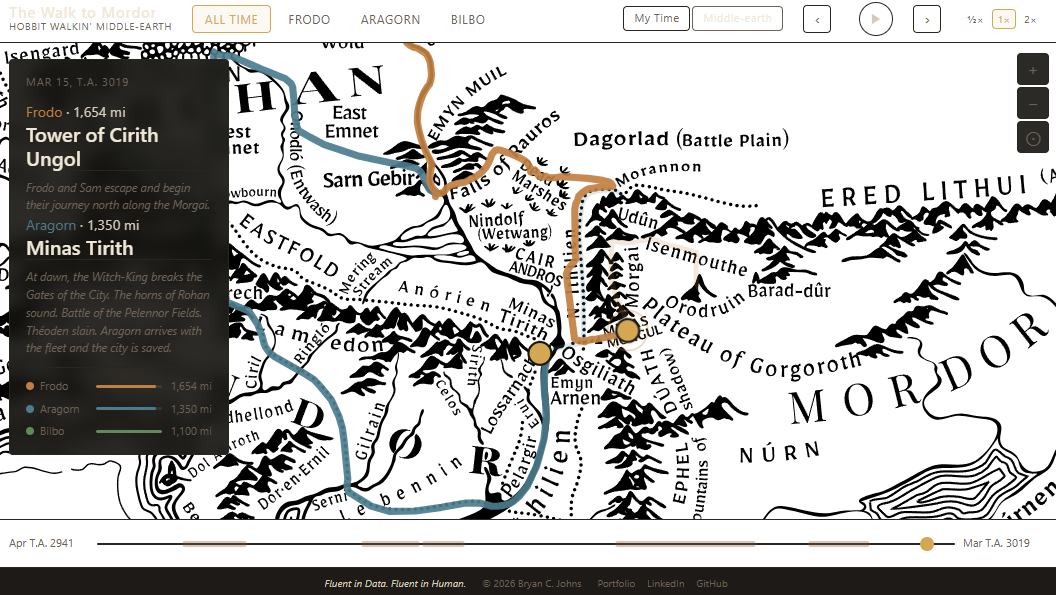 Middle-earth Time, T.A. 3019: Frodo escaping the Tower of Cirith
Ungol while Aragorn reaches Minas Tirith. Both journeys are active
on screen simultaneously during the final weeks of the War of the
Ring — the visualization's most distinctive moment.
Middle-earth Time, T.A. 3019: Frodo escaping the Tower of Cirith
Ungol while Aragorn reaches Minas Tirith. Both journeys are active
on screen simultaneously during the final weeks of the War of the
Ring — the visualization's most distinctive moment.
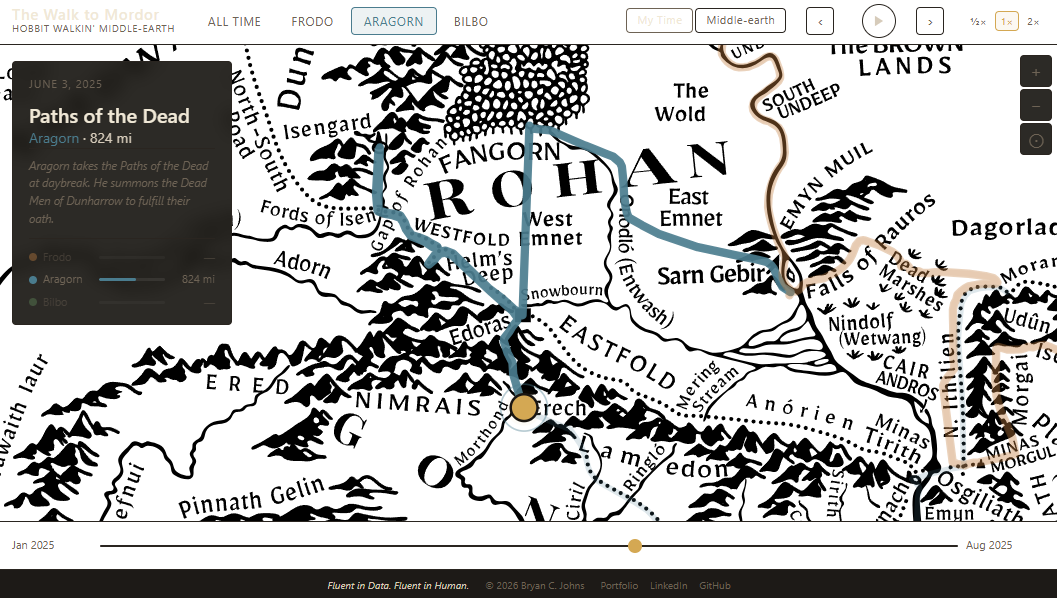 Aragorn, My Time, June 3, 2025: the Paths of the Dead. The info
panel shows the current location, cumulative miles, and Tolkien's
narrative event. The revealed route traces everything walked so
far.
Aragorn, My Time, June 3, 2025: the Paths of the Dead. The info
panel shows the current location, cumulative miles, and Tolkien's
narrative event. The revealed route traces everything walked so
far.
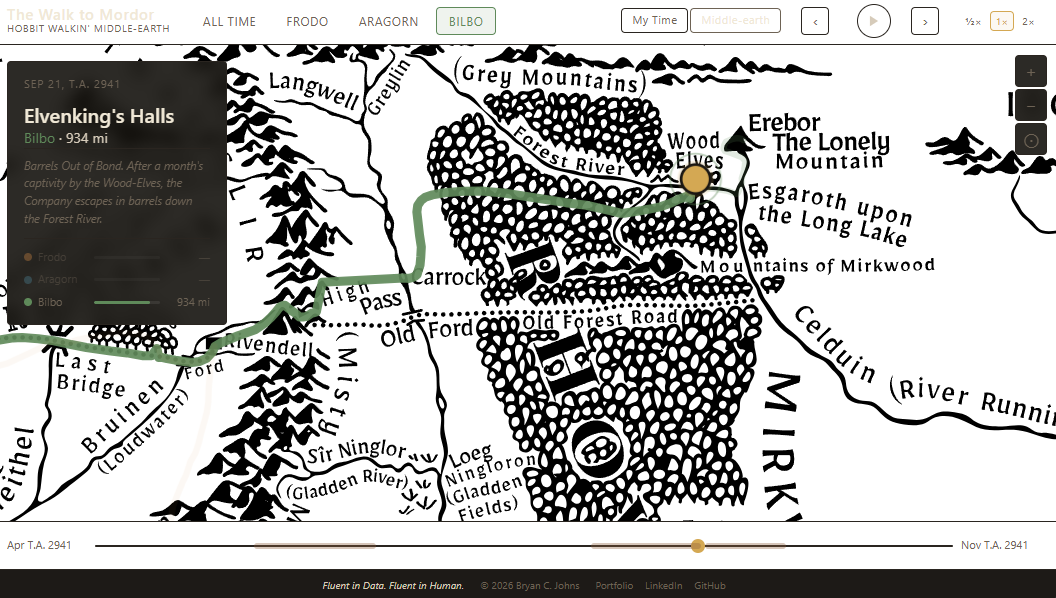 Bilbo, Middle-earth Time: September T.A. 2941, escaping the
Elvenking's Halls near the Lonely Mountain. Bilbo's journey runs
on its own Shire Calendar, 78 years before Frodo and
Aragorn's.
Bilbo, Middle-earth Time: September T.A. 2941, escaping the
Elvenking's Halls near the Lonely Mountain. Bilbo's journey runs
on its own Shire Calendar, 78 years before Frodo and
Aragorn's.
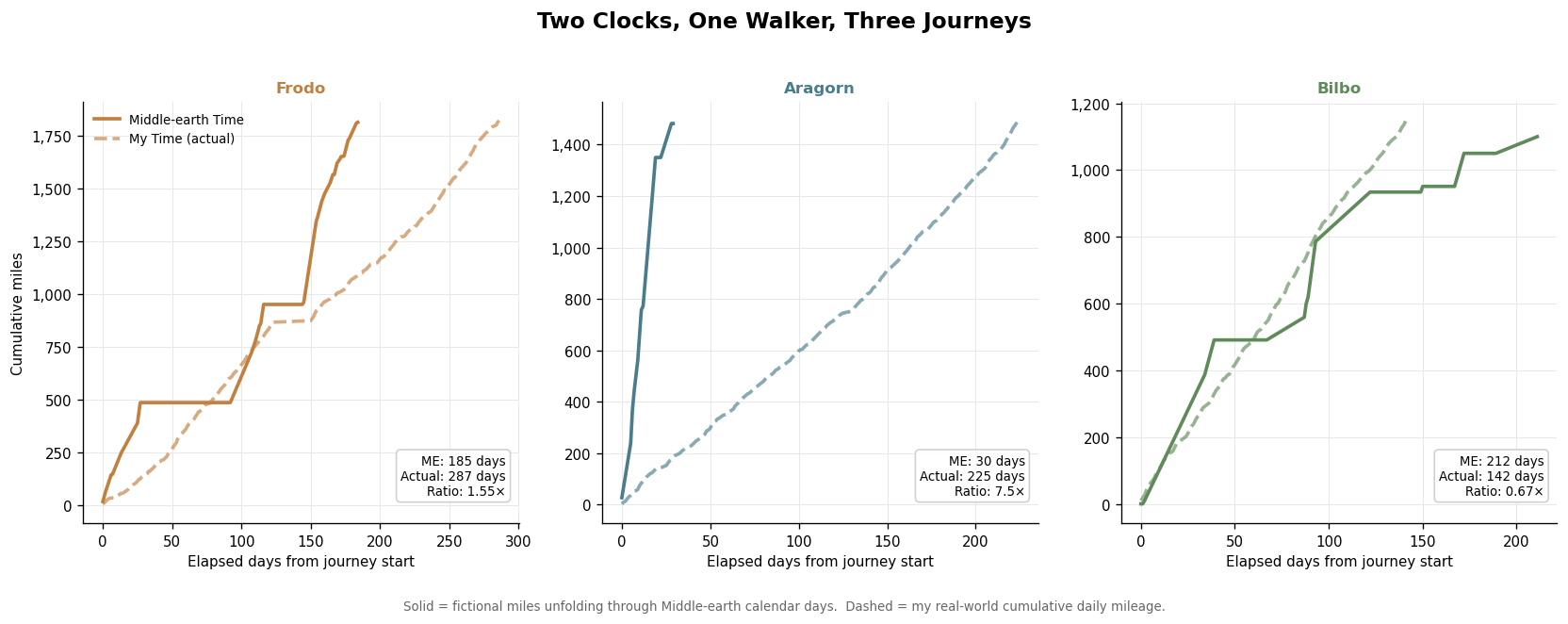 The same fictional mileage, read through two clocks. My Time
rises steadily; Middle-earth Time shows long flat plateaus for
Rivendell, Lothlórien, and the Wood-elves' captivity — periods
when the fictional timeline stands still while real-world walking
continued.
>
The same fictional mileage, read through two clocks. My Time
rises steadily; Middle-earth Time shows long flat plateaus for
Rivendell, Lothlórien, and the Wood-elves' captivity — periods
when the fictional timeline stands still while real-world walking
continued.
>
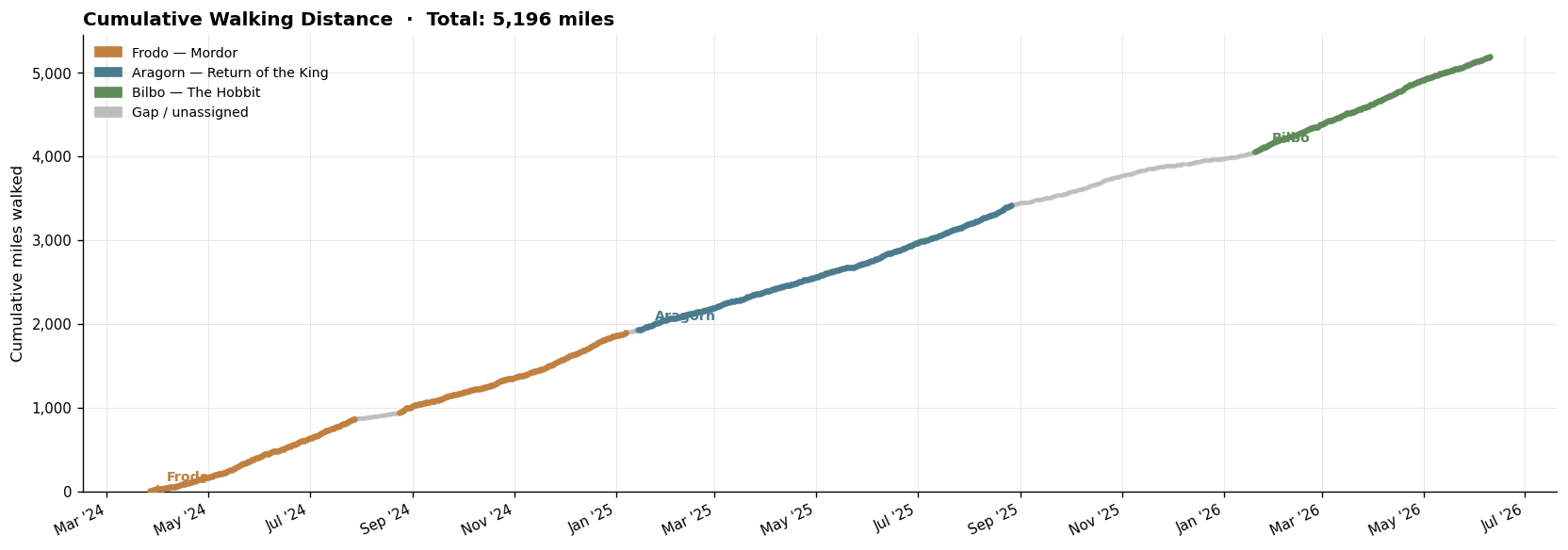 5,196 miles over 806 days. Grey segments show gap periods between
challenges. The consistently steady slope across two years
reflects a daily walking habit, not a challenge-driven burst. This
is a daily walker, not a weekend athlete.
5,196 miles over 806 days. Grey segments show gap periods between
challenges. The consistently steady slope across two years
reflects a daily walking habit, not a challenge-driven burst. This
is a daily walker, not a weekend athlete.
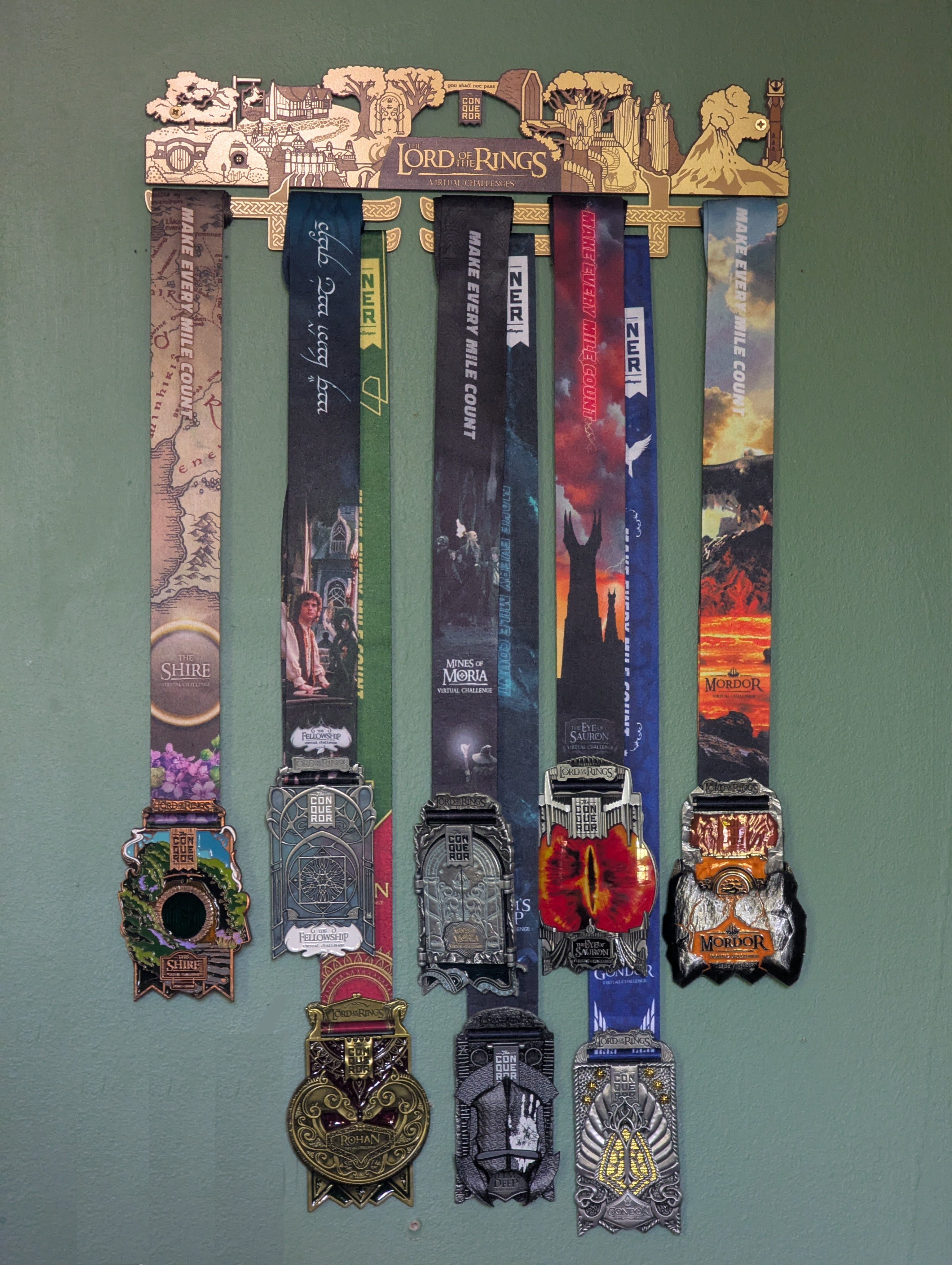 Completion medals for the Walk to Mordor challenges, from
The Conqueror.
Completion medals for the Walk to Mordor challenges, from
The Conqueror.
References
- Tolkien, J.R.R. The Hobbit, The Lord of the Rings (including appendices), Unfinished Tales. Published by HarperCollins / Houghton Mifflin Harcourt.
- Fonstad, Karen Wynn. The Atlas of Middle-earth, revised edition. Consulted as a secondary reference for routes, locations, and geography.
- mapome by k1tesurfen — Middle-earth base map used for the visualization. Licensed CC BY-SA 4.0.
- The Conqueror — virtual walking challenge mileage and segment framework.
- Google Fit — source of personal walking data; only daily aggregate distances are published.
This is an independent, unofficial, non-commercial fan project. It is not affiliated with or endorsed by The Conqueror, the Tolkien Estate, or the publishers of Tolkien's works. Middle-earth-related names and material, challenge branding, and other third-party assets remain subject to their respective rights. Attribution does not imply endorsement or permission. See the repository README for additional attribution and licensing.