When international travel stopped for COVID, tourism-dependent small island economies felt the shock. But did greater dependence also mean a harder road to recovery?
Project Links
I worked in tourism in the U.S. Virgin Islands for several years. I know the tangled relationship between visitors, locals, and the economy firsthand. While examining how the USVI weathered a hurricane and a pandemic for another project, I decided to broaden the comparison to other small island economies.
Project Overview
For many small island economies, tourism is woven into the economic fabric: jobs, public revenue, foreign exchange, and local livelihoods all depend on it. What happens when that activity suddenly stops?
I examined the relationship between pre-pandemic tourism dependence and the economic shock of 2020 across 29 Small Island Developing States and other small island economies. Using international visitor-spending data from Our World in Data and complementary World Bank tourism indicators, I built a reproducible R analysis comparing exposure, contraction, and recovery.
The pattern was clear: economies more dependent on international visitor spending generally experienced sharper contractions in 2020. But this relationship did not extend to recovery: tourism dependence was not significantly associated with where economies stood relative to 2019 GDP by 2024. By then, 21 of 28 economies had regained their aggregate GDP, while 20 had regained GDP per capita.
The larger lesson is that vulnerability and recovery are not mirror images. Understanding either requires looking beyond a single indicator—and being attentive to what the data can, and cannot, tell us.
Gallery
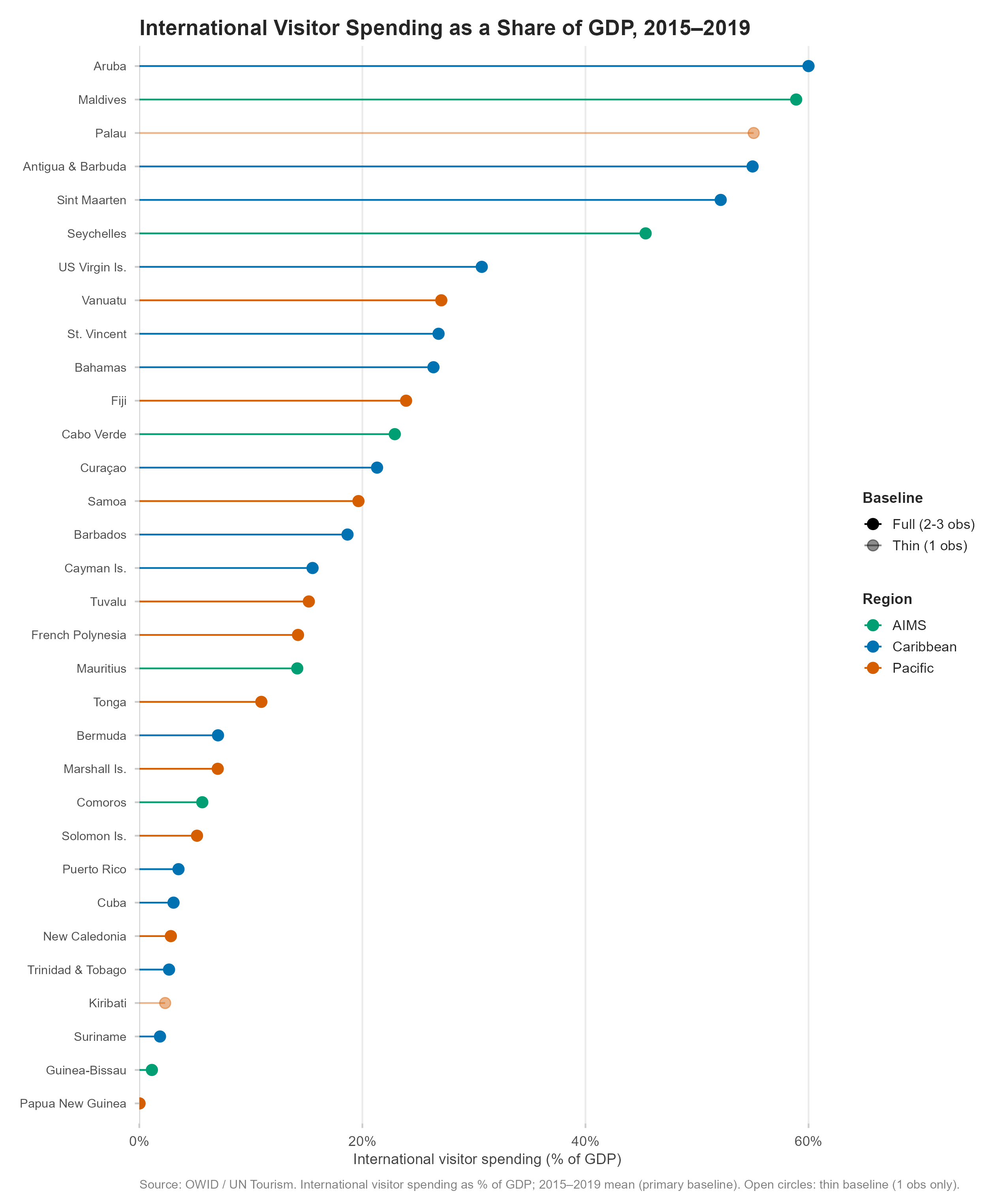 Pre-pandemic tourism dependence varied enormously. International
visitor spending exceeded 60% of GDP in Aruba and the Maldives,
while it represented a negligible share in economies such as Papua
New Guinea and Guinea-Bissau.
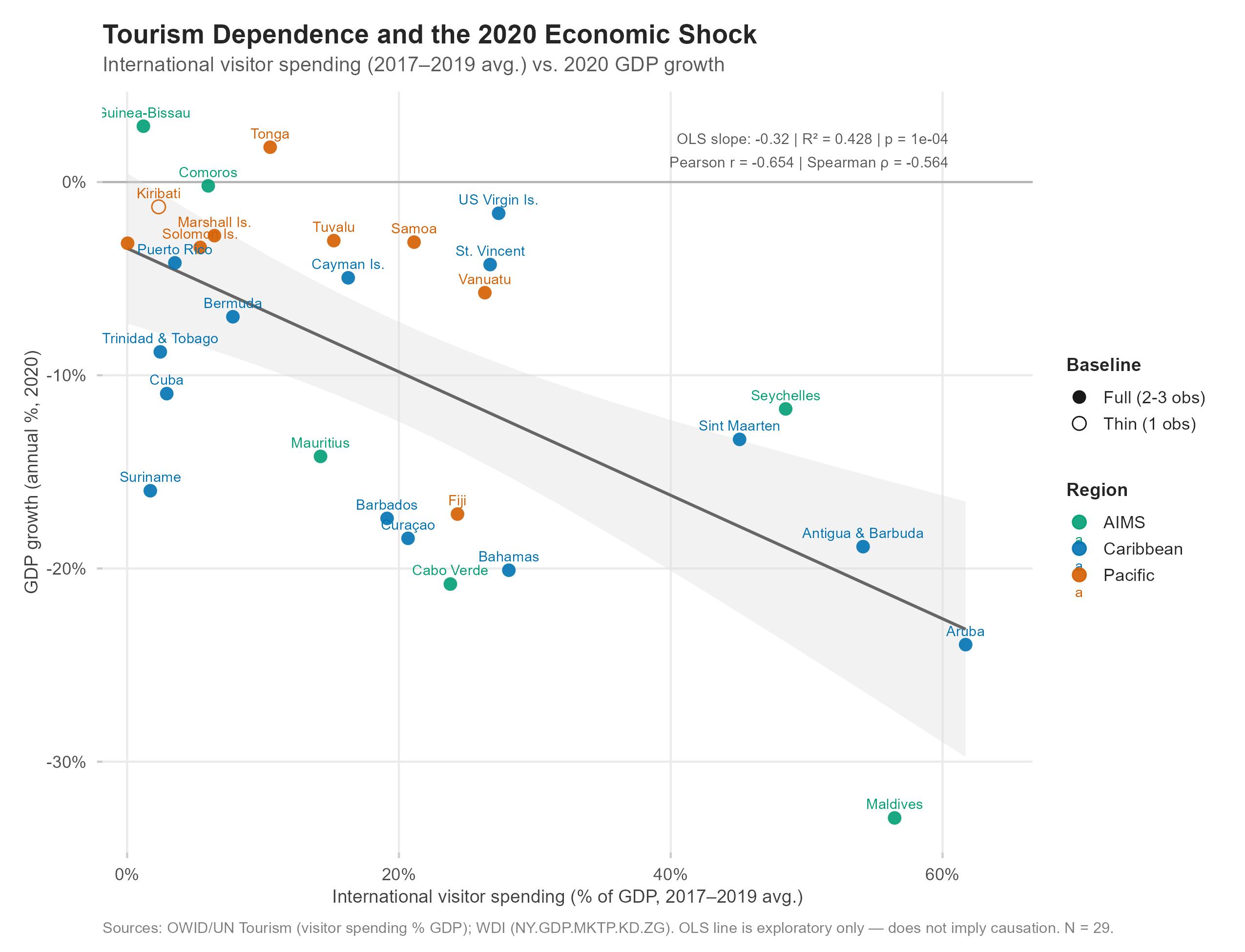 The central finding: economies where international visitor
spending made up a larger share of GDP tended to experience deeper
contractions in 2020. The relationship is clear, but it is an
association across economies — not proof that tourism dependence
alone caused the shock.
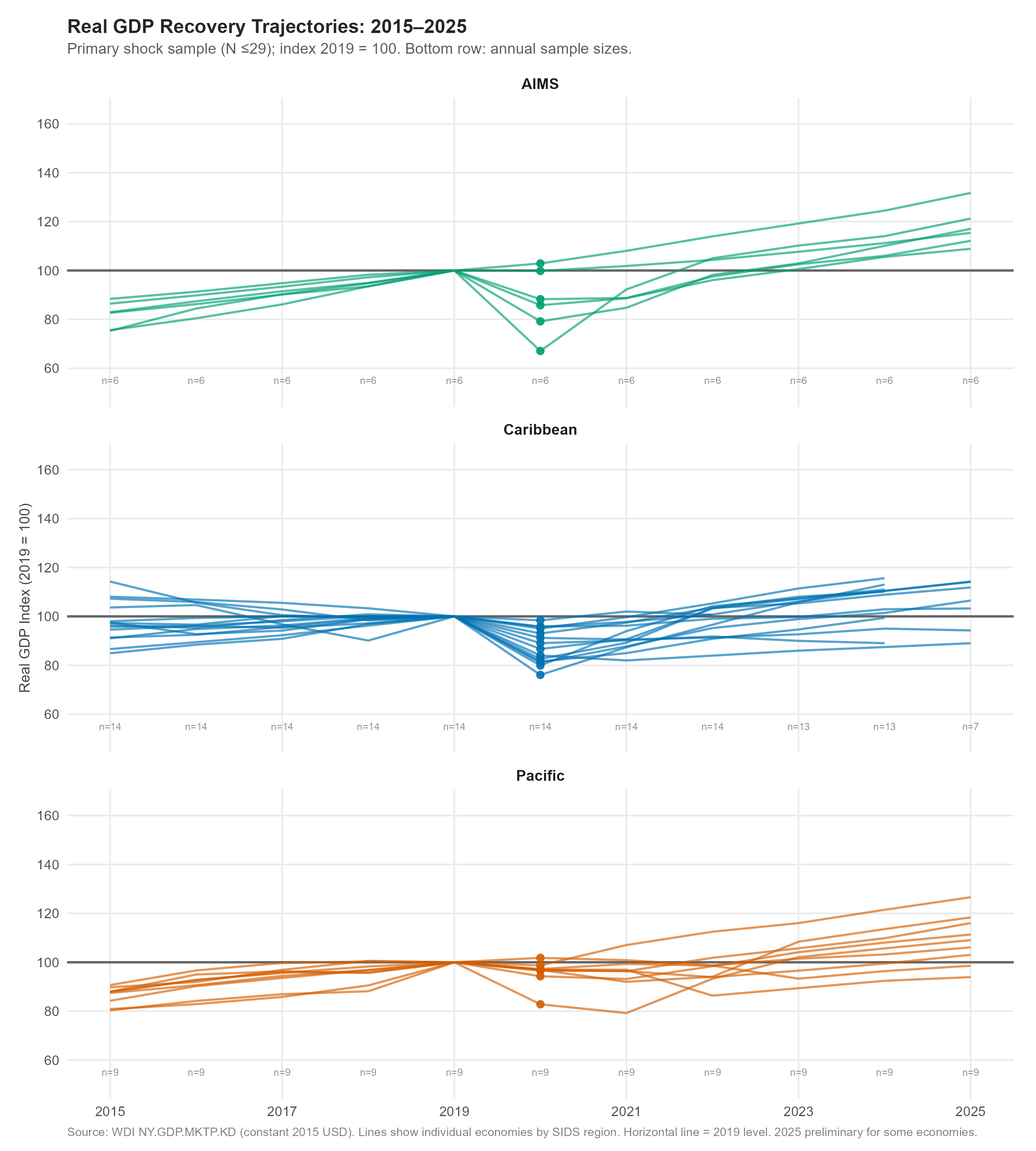 The rebound was not uniform. Most economies returned to their
2019 aggregate output by 2024, but the paths differed
considerably. And aggregate GDP recovery does not necessarily mean
that output per person has recovered. 2025 estimates are
preliminary for some economies.
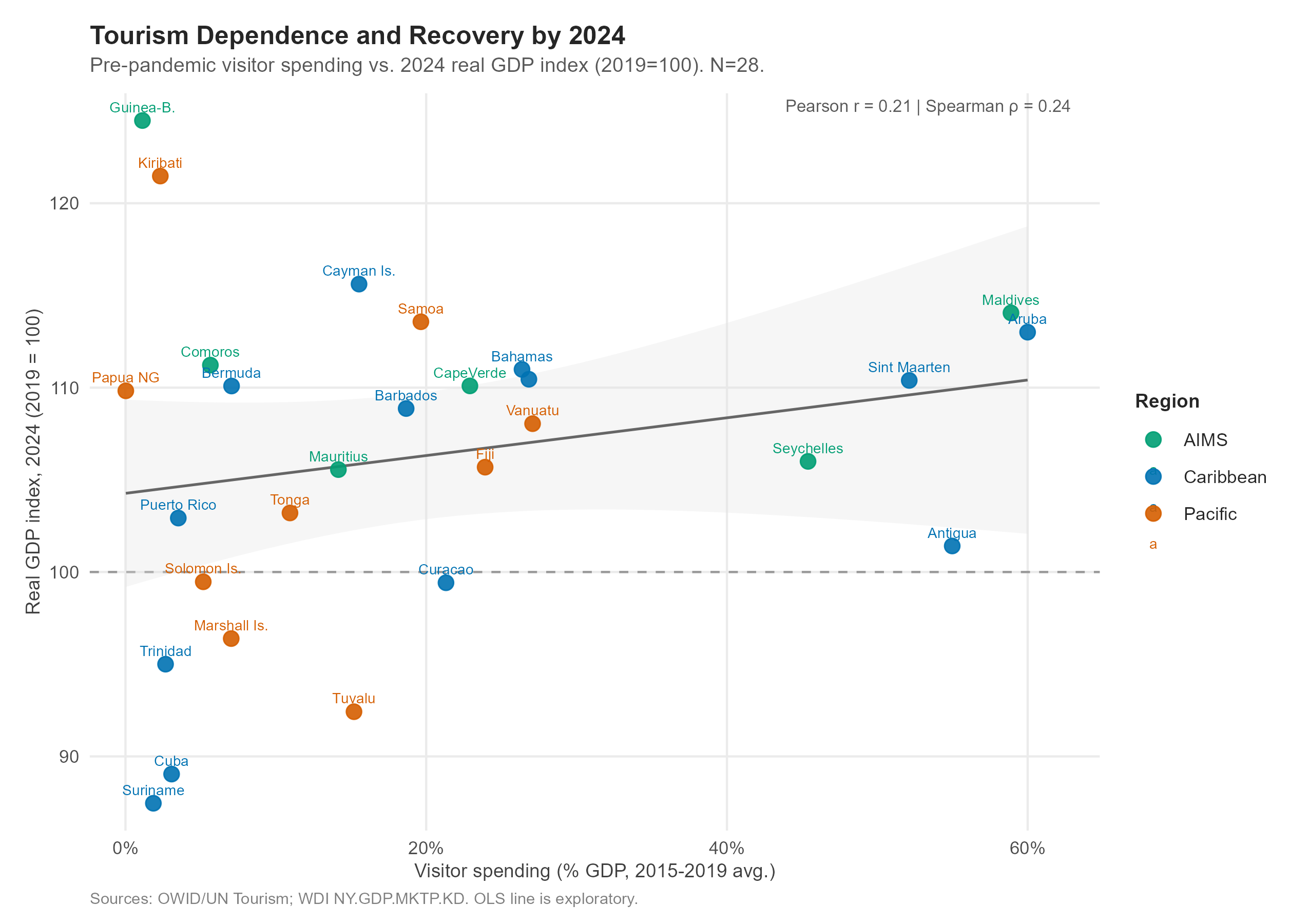 The relationship visible in the 2020 shock does not carry through
to the 2024 endpoint: pre-pandemic tourism dependence was not
significantly associated with the 2024 real-GDP index.
References
- Our World in Data: Tourism — International visitor spending and tourism-related indicators.
- World Bank: World Development Indicators — Tourism receipts, GDP growth, real GDP, and real GDP per capita.
- UN-OHRLLS: Small Island Developing States — SIDS classification and candidate-economy framework.